|
Home
Alphabetical list of all titles
The Tschiffely Collection
The Hanbury-Tenison Collection
The Cunninghame Graham Collection
Wanderreiter Klassiker
The Isabella Bird Collection
General
Africa
Asia
Australia and the Pacific
Europe
The Indian Subcontinent
Latin America
North Africa and the
Middle East
North America
The
Orient
Antarctica
Horse Packing and Travel
Our Publishing Mission
Equestrian Travel books by other
publishers
Visit The Long Riders' Guild - the world's first international
association of equestrian explorers!
Visit The Long Riders' Guild
Academic Foundation - "Science, not Superstition."

Visit Classic Travel Books for more exciting travel tales!
Website designed by Basha
O'Reilly
| |
Horse Packing and Travel
In an effort to further its educational mission, Horse Travel Books
is attempting to republish the most important
titles ever written relating to equestrian travel, classic equitation, and horse
packing. Often this involves locating rare volumes which can only be purchased
at great expense. The information lodged in these books is however too valuable
to be neglected.
|
ISBN 159048052X
|
The
Art of Travel, Francis Galton - Originally
published in 1855, this book was written after Francis Galton returned
from a historic journey into the African interior where he suffered much
hardship and danger. After his return to England the famed explorer
determined to teach travelers and soldiers the art of self-sufficiency in
the field. His literary effort, “The Art of Travel,” became an instant
classic and was used by a host of now-famous explorers, including Sir
Richard Francis Burton of Mecca fame.
The volume covers a diverse variety of subjects, some expected, as well as
a few which are now of great historical interest. Readers will discover
how to ride horses, handle elephants, and avoid cobras. Also included are
sections on how to pull teeth, find water in a desert, and construct a
sleeping bag out of fur. However “The Art of Travel” also includes
detailed information not only on how to organize an African safari but how
to discipline the irascible wives of the porters as well!
Amply illustrated with dozens of nineteenth century drawings, this
rediscovered classic remains fascinating reading for students of the horse
or history.
Go
to Amazon.co.uk
or Barnes
& Noble |
|
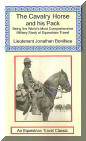
ISBN 1590481720
|
The
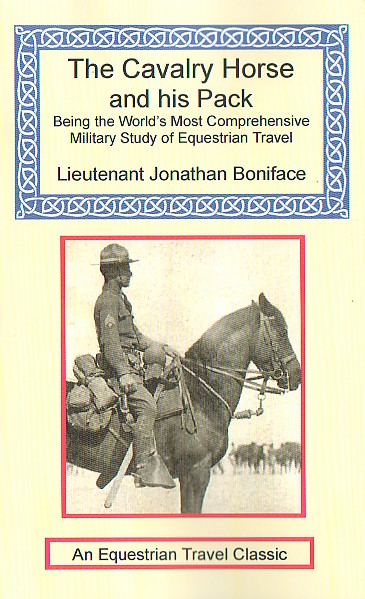
Cavalry Horse and his Pack, Lieut. Jonathan Boniface - This is quite simply the most important book ever
written in the English language by a military man on the subject of
equestrian travel.
It was designed
to be used by the United States cavalry. Yet it differs from traditional
army manuals in that instead of emphasizing mounted maneuvering, it
concentrates on the preparation and practice of journeying on horseback. If
you want to learn how cavalry men charged into battle waving sabers, this
isn’t the book for you. If you want to learn how to properly pack and ride a
horse over extremely long distances, then you are holding the cavalry man’s
sacred text in your hands.
The author,
Lieutenant Jonathan Boniface, traveled from Asia to Europe in search of the
most valuable equestrian travel knowledge. He lists seventy-eight primary
sources, including the finest equestrian scholars of the time, from a
variety of countries. Boniface takes the reader through the step by step
process of finding the best riding horse, proper saddling, rules for daily
travel, care of the horse, and possible dangers. He also devotes a section
of the book to working and traveling with pack horses and mules. At more
than five hundred pages, the book represents the largest international study
of its kind. Plus, the text is packed with nearly two hundred excellent
photographs and diagrams. It is a superb literary achievement !
At the dawn of
the 20th century experts were busy predicting the imminent demise
of the horse. Mankind’s most historically influential comrade would make way
for the automobile, cynics said. Yet the young
author of this remarkable volume disagreed with the critics.
No machine of
steam and steel, of cog or cam, no vapor-fed motor, no craft propelled by
batteries or boilers would ever successfully displace the horse from our
on-going needs, advised Boniface.
Part text book,
part history book and all inspiration, “The Cavalry Horse and his Pack” is
the lasting tribute to the great horseman and talented writer who foresaw
the day when horse travel would once again flourish and a book such as this
one would be cherished by unforeseen generations of Long Riders, cavalry
students and horse lovers.
Go to Amazon.co.uk or
Barnes & Noble.
|
|
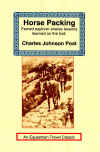
ISBN 159048049X
|
Horse
Packing, Charles Johnson Post - Unlike
the majority of authors who had written on the subject, Post was not only
a former military man, he had also made a record-breaking equestrian trip
through the rugged Andes mountains of South America. Originally published
in 1914, “Horse Packing” was an instant success, incorporating as it
did not only the very essence of the science of packing horses and mules,
but giving Post’s own valuable insights into what had personally worked
for him out on the trail.
The book is amply illustrated with a multitude of drawings showing how to
secure loads, tie an assortment of various rope hitches, and even choose
the proper pack animal. This rediscovered classic remains fascinating
reading for students of the horse or history.
Go
to Amazon.co.uk
or
Barnes & Noble |
|
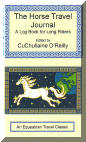
|
The
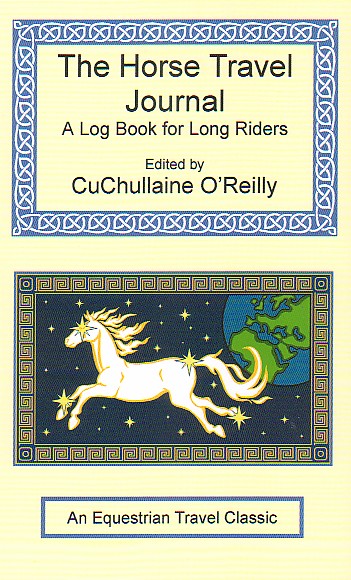
Horse Travel Journal, Edited byCuChullaine O'Reilly - The critical need for a standardized Horse Travel
Journal was recognized by the Founding Members of The Long Riders’ Guild
in the year 2000, during their first international meeting of equestrian
explorers. All of these mounted travellers shared stories about their
assorted unsuccessful efforts to maintain a written record of their
equestrian adventures. Though various literary avenues had been tried, no
one had devised a book specifically designed to record the equestrian
occurrences encountered during these long and often perilous journeys.
Thus was born the
need and desire to publish a book intended to register the most important
comments and observations of the world’s Long Riders. It has been
designed to fit into a standard saddle bag. Every daily diary entry in
The Horse Travel Journal allows the Long Rider to make concise notes on
the specifics of that day’s journey, the condition of the horses, problems
encountered, etc. Additional pages are provided for personal recollections
about daily events.
In addition, at
the rear of the book, The Horse Travel Journal contains the world’s
first Long Rider Pictionary. In their initial meeting it was discovered that
despite the fact that many of the Long Rides were fluent in several foreign
languages, normal linguistic training did not include the necessary
equestrian terms often encountered during the course of such a journey. How
does one say “have you seen my stallion” in Mongolian at midnight, for
example? Now, with the aid of the Long Rider Pictionary, the equestrian
traveller can point to the object in question in his or her search for local
linguistic assistance.
Finally, when
completed these Journals will contain equestrian travel information of
immense historical and geographical importance. To ensure ownership of the
Journal, information is provided whereby it may be returned to the
equestrian explorer, via The Long Riders’ Guild, in case the Journal is lost
or stolen. No book is a substitute for experience. But this one is designed
to record the activities of the world’s Long Riders at the dawn of the 21st
century.
Please go to
Barnes & Noble or
Amazon.co.uk |
|
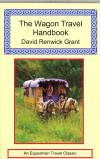
ISBN 1590482379
|
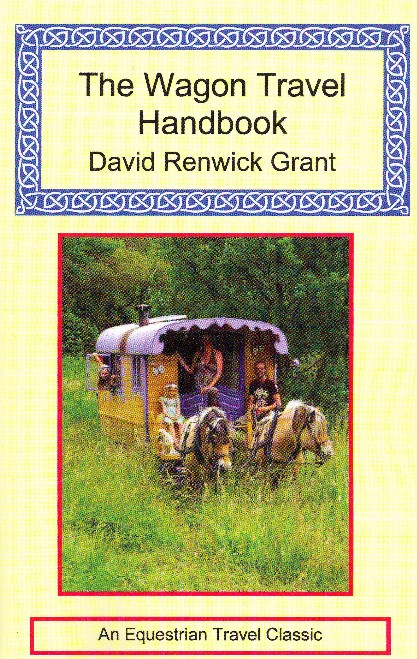
The Wagon Travel Handbook, David
Renwick Grant -
Until the dawning of
the 20th century wagons of all sorts, shapes and sizes were
mankind’s main mode of travel. From donkey dray to ducal carriage, prairie
schooner to farm cart, wagons assisted mankind with his labour or liberated
him to explore the world. Sadly one of the victims of the internal
combustion engine was the ancient art of wagon travel.
Even in this day of GPS satellites and
computerised cars, there are those who aspire instead to see the world glide
by no faster than the trot of their gently pacing horse-drawn wagon. Yet
had you longed to learn how to undertake a wagon journey, who could have
taught you the everyday skills needed to travel across a host of countries
and climates? You would have sought in vain for a guide to this lost
knowledge - until now.
This is the finest book ever penned about
modern wagon travel, a volume which embodies a wealth of hard-earned
experience and lore gained by David Grant. He is the legendary Scottish
wagon-master who journeyed around the world with his family in a horse-drawn
wagon, thereby gaining entry into The Guinness Book of World Records.
Grant has filled The Wagon Travel
Handbook with all the practical information a first time-wagon traveller
will need before setting out, including sections on interior and exterior
wagon design, choice of draught animals, veterinary requirements and
frontier formalities. Also included are valuable personal accounts gleaned
from other modern wagon masters interviewed for this book, including the
young couple travelling from Pennsylvania to Patagonia and the family who
has spent the last five years slowly discovering the beauties of Europe.
Their collective problems, and inventive solutions, are presented in this
amply illustrated volume, as is the remarkable story of the most famous
wagon traveller of the 19th century.
If you have ever yearned to set off on the
journey of a lifetime aboard a horse-drawn wagon, then this is the book that
will turn that dream into a reality. Or perhaps you’re an armchair traveller
who merely wishes to enjoy a vicarious read and ride? Either way, this book
will delight and inform your voyage of discovery.
For more information, please go to
Amazon.co.uk or
Barnes & Noble.
|
|
ISBN 1590480465
|
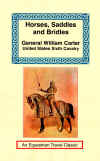
Horses,
Saddles and Bridles, General William Carter - General
William Harding Carter served with the United States Sixth Calvary and was
considered one of that country’s foremost experts on both the horse and
his equipment. This volume covers a wide range of topics including basic
training of the horse, care of its equipment, managing a stable, and
riding methods.
Additionally,
“Horses, Saddles and Bridles” provides a fascinating look back into
equestrian travel history. Carter provides case studies of various cavalry
campaigns, detailing for example how Napoleon lost more than 186,000
horses in his ill-fated Russian campaign!
Amply illustrated,
this rediscovered classic remains fascinating reading for students of the
horse or history.
Go
to Amazon.co.uk
or
Barnes & Noble |
|
ISBN 1590480457 |
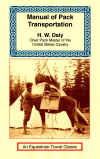
The
Manual of Pack Transportation, H. W. Daly
- Henry
W. Daly was the last of the old-time packers who learned their trade under
the tough tutelage of General George Crook. Though he later rose to the
rank of Chief Pack Master of the U.S. Army, Daly became a packer in the
late nineteenth century while helping Crook chase the Apache leader
Geronimo across that blazing wilderness known as the Arizona Territory.
In later years Daly made an effort to record all the knowledge he had
gained from his decades of field experience. The resultant book “The
Manual of Pack Transportation” is his masterpiece. It contains a wealth
of information on various pack saddles, ropes and equipment, how to secure
every type of load imaginable, instructions on how to organize a pack
train, and the duties of various individuals including the chief packer,
blacksmith, cook, etc.
More than a reference book, “The Manual of Pack Transportation” is
also a hands-on time capsule capable of carrying the reader back to the
days when equestrian travel was king. It is amply illustrated with both
photographs and drawings.
Go
to Amazon.co.uk
or
Barnes & Noble. |
|
ISBN 1590480635
|
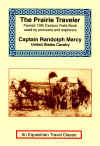
The
Prairie Traveler, Randolph Marcy - There
were a lot of things you packed into your saddlebags or the wagon before
setting off to cross the North American wilderness in the 1850s. A gun and
an axe were obvious necessities. Yet many pioneers were just as adamant
about placing a copy of Captain Randolph Marcy's “The Prairie
Traveler” close at hand. Next to the family Bible, it was considered an
absolute necessity for anyone planning to venture through the hazards of
trans-continental travel.
Though Marcy eventually became a brigadier general in the United States
army, he made his reputation as one of America’s early experts on
frontier travel after tracing the Red River to its source. Soldier,
trailblazer and mapmaker, Marcy conducted five major expeditions across
the wilderness that was once the American West, then submitted a series of
reports to the War Office describing the country, its vast resources, and
the hazards involved in crossing it. It was from these original reports
that the legendary frontiersman drew when he wrote what was to become an
encyclopedic work on frontier life.
Packed with practical advice for travelers heading West, “The Prairie
Traveler” issues advice on such diverse subjects as how to organize a
wagon train, march with loose horses, choose proper pack saddles, ford
rivers, administer rudimentary first aid, or avoid Indian attack. In
addition he dispensed detailed notes on thirty-four of the most important
overland trails used by American pioneers. Legendary English explorer, Sir
Richard Francis Burton, was one of the many explorers to use this famous
travel book when he traveled from Texas to Utah in the late 1850s.
Amply illustrated with pen and ink drawings of the time, this rediscovered
classic remains fascinating reading for students of the horse or history.
Go
to Amazon.co.uk
or
Barnes & Noble. |
|
ISBN 1590481372 |
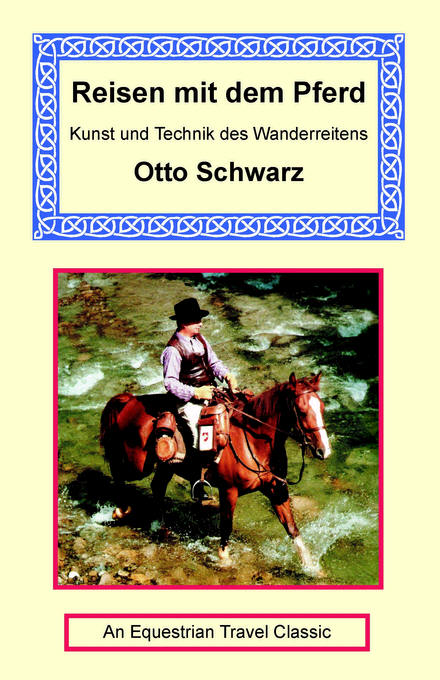
Reisen mit dem Pferd, Otto Schwarz
- The story of Otto Schwarz
reads like a mounted Odyssey. As the clouds of the Second World War gathered
over his native Switzerland, young Otto Schwarz was competing at Olympic
level in dressage. Forced by circumstances to don the uniform of a Swiss
cavalry officer, Otto patrolled the French-Swiss border on horseback for
nearly five years. Those mounted adventures gave the dashing Captain Schwarz
a taste for horse travel which redirected his equestrian life.
Over the course of the next sixty years, Otto Schwarz went on to journey
48,000 kilometres (30,000 miles) on horseback across five continents, making
him the most well-travelled Long Rider of the 20th century. The man
literally rode in a host of places including Japan, Europe, Africa and North
& South America.
The amazing story of Otto's many equestrian adventures is available for the
first time in more than twenty years in this re-issued version of his
classic book, "Reisen mit dem Pferd." In addition, the famous Long Rider
offers his readers a detailed supplement on how to prepare and undertake an
extended equestrian journey.
This important book, (written in German), belongs on the bookshelf of every
student of equestrian travel.
Click here to go to Amazon.co.uk or
Barnes & Noble. |
Home
|